Is Your Latest Hire Failing to Perform? Maybe It's You.
Is your latest hire failing to perform?
Maybe the reason has nothing to do with them. Maybe it's you.
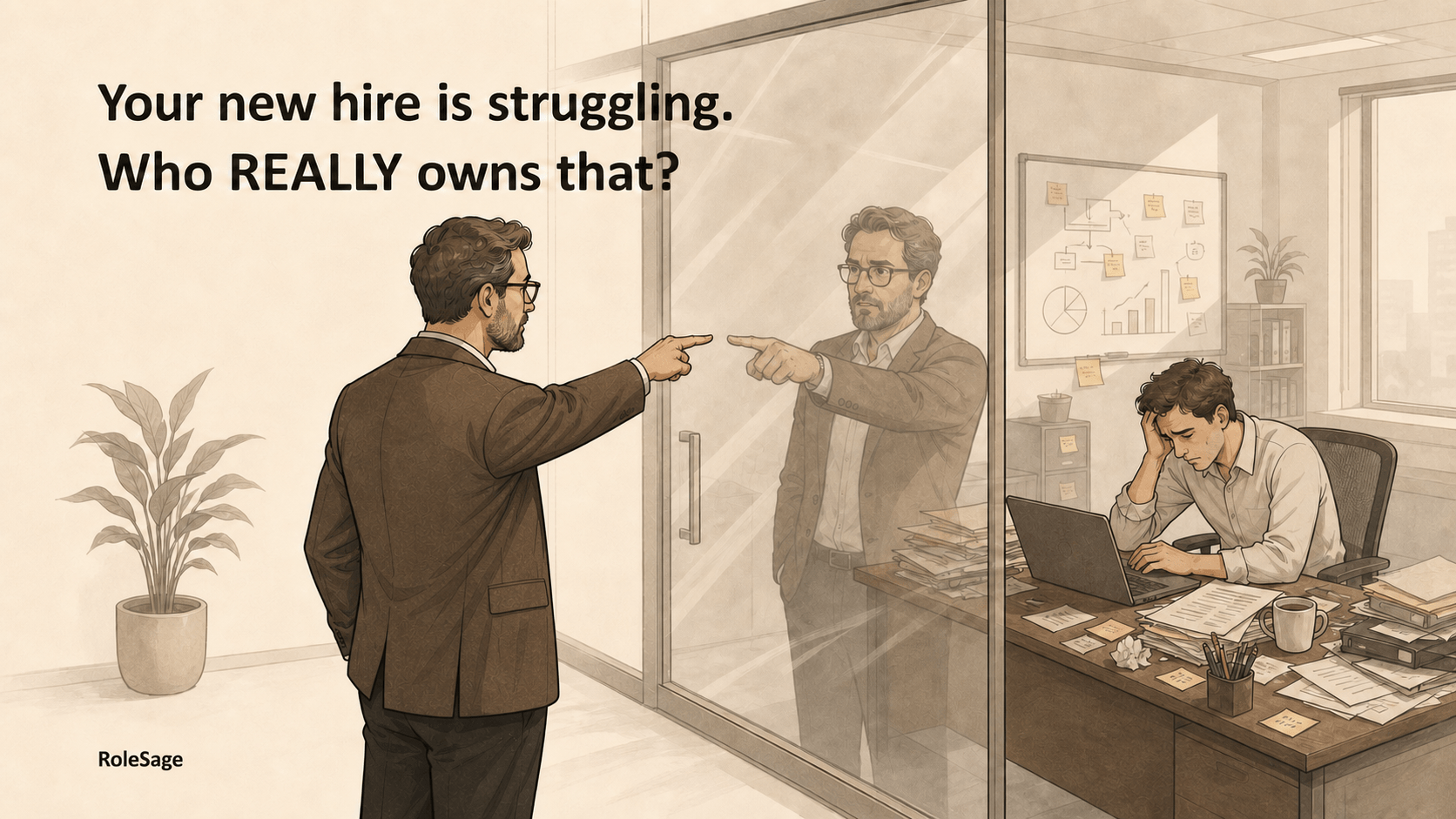
“You” can be fairly broad here. It could mean the hiring team, the wider company, or senior leadership. But most of the time, it falls most directly on the new hire's manager.
One of the principles in Jocko Willink and Leif Babin's Extreme Ownership is blunt: “No Bad Teams, Only Bad Leaders”.[1]
The point is not that every employee is secretly brilliant, or that an employee can never be held accountable. The point is that leadership does not get to stand back, blame the team, and absolve itself of accountability.
Yes, sometimes you hire the wrong person
Let's acknowledge the obvious. Sometimes a person is not a good fit for a role.
But honestly, even in those cases, if you hired them, it still falls back on you.
Maybe the role was poorly defined. Maybe your hiring process tested the wrong things. Maybe you accepted confident claims without enough evidence. Maybe warning signs were missed because you were rushing to fill the position.
If the person should never have been hired, there is a problem with your process.
That is not comfortable, but it is ownership.
If they are failing, how are you failing them?
Maybe there is an onboarding issue.
Maybe there is a training issue.
Maybe expectations were never made clear. Maybe the work changed after they arrived. Maybe the direct manager and the new hire genuinely have a personality conflict.
Maybe the employee does not have the information, support, authority, tools, or feedback needed to win.
If they are failing, leadership must ask how leadership is failing them.
That question should come before the easier conclusion that the employee is simply the problem.
This is not a get-out-of-jail-free card
New employees who are struggling still have responsibilities. They need to be honest about what they do not understand, where they are falling short, and what help they need. They need to listen to feedback and act on it.
But does your company have a culture where they can say those things?
Does the team feel psychologically safe raising problems, admitting weaknesses, and discussing what they are struggling with? Or do people expect blame, embarrassment, or backlash when they speak honestly?
Psychological safety does not mean freedom from standards or consequences. It means people can surface problems while there is still time to solve them. Amy Edmondson's foundational research connected team psychological safety with learning behaviour.[2]
If your culture punishes people for admitting difficulty, do not be surprised when they hide difficulty until it becomes failure.
Look at the system—and then look at leadership
Maybe you need to improve your hiring process, onboarding, or training. You probably do. These are systems that should be reviewed and improved continually.
RoleSage can help make part of that review more honest by preserving the role requirements, the candidate's evidence, the gaps identified, and the reasoning used during hiring. It cannot lead the team for you. But it can make it harder to rewrite the hiring story after things go wrong.
Do not stop at process, though. Look at how leadership functions at every level.
Is leadership effective? Is it helping new starters and existing team members to win? Does it believe in the mission, keep expectations and plans simple, and check its ego when things go wrong?
Or does it wait for poor performance and then place the blame somewhere else?
Your latest hire may genuinely be struggling. They may even be wrong for the role.
But you hired them. You onboarded them. You trained them. You set the expectations. You created the environment in which they are now succeeding or failing.
The employee owns their actions.
Leadership owns the outcome.
References and further reading
- Echelon Front: How to Improve Communication Within a Team - an explanation of the “No Bad Teams, Only Bad Leaders” principle from the authors of Extreme Ownership.
- Amy Edmondson: Psychological Safety and Learning Behavior in Work Teams - foundational research on team psychological safety and learning behaviour.